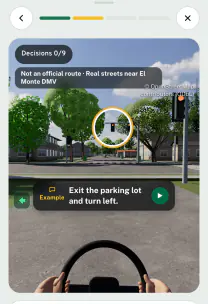
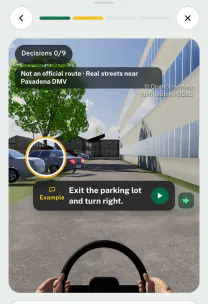
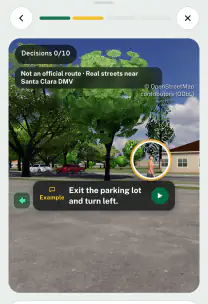
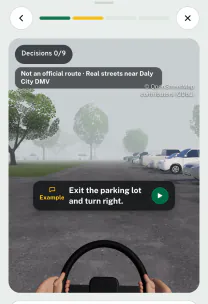
About 20 minutes with a DMV examiner. You pass with zero critical driving errors, no more than 15 scored errors, and no more than 3 misses on pre-drive items 9 to 14. There’s no parallel parking; there is straight-line backing.
First a pre-drive safety check, then the Driving Performance Evaluation, with a DMV examiner beside you for about 20 minutes.
You pass with zero critical driving errors, no more than 15 errors on the scored maneuvers, and no more than 3 misses on pre-drive items 9 to 14. Adults take the same test as teens.
Items 1 to 8 and 15 to 17 are about the car: if one fails (say, a brake light is out), the test is rescheduled, not failed.
Items 9 to 14 are controls you must find or show; missing 4 or more fails the test. In bad weather you must show the wipers, defroster, hazards and headlights work.
At least two: one outside on the left, the other inside (center) or outside on the right. They must be secure, unbroken and clear.
4. Turn signals
Left and right signals, front and back, must all work.
5. Brake lights
Both the left and the right brake light must work; the center third light does not count.
6. Tires
Each tire needs at least 1/32 inch of tread in any two adjacent grooves; no bald tires. The handbook adds that a donut spare is not allowed. California Driver Handbook: The Testing Process
7. Foot brake
When pressed, the pedal must stay at least 1 inch above the floor.
8. Horn
Must be designed for the vehicle, work, and be heard from at least 200 feet. A bicycle horn does not count.
9. Parking brake Show it
Show where it is and how to set and release it. If it does not hold, the test is rescheduled as a mechanical failure.
Locate the wiper control and/or operate the wipers.
12. Defroster Show it
Locate the front windshield defroster button.
13. Emergency flashers (hazard lights) Show it
Locate the hazard-light switch.
14. Headlights Show it
Locate the headlight switch.
15. Passenger door
The front passenger door must open and close properly.
16. Glove box
The glove box door must stay securely closed.
17. Seat belts
Working belts for you and the examiner, and everyone in the car must wear one.
18. Head restraint
Item 18 on the current DL 32 score sheet; we found nothing on dmv.ca.gov about what is checked. Safe bet: headrests installed and adjusted. DMV score sheet DL 32 (PDF)
19. Driver-assist features
DL 32 has an ‘Automated Technology Y/N/U’ box; we found nothing on dmv.ca.gov that explains it. The handbook bans driver-assist technologies such as automated parallel parking, lane-departure systems and adaptive cruise control during the test, so know how to switch them off. DMV score sheet DL 32 (PDF)California Driver Handbook: The Testing Process
What the examiner looks for in each of the 11 maneuvers
Parking-lot driving
Scans ahead, behind, left and right for cars, cyclists and pedestrians, turns the head toward them, yields when needed, and drives slowly and in control.
Straight-line backing
Pull to the curb: traffic and blind-spot check, signal before, cancel after. Back up: look over your right shoulder through the rear window (mirrors or camera alone don’t count), about 3 vehicle lengths within 3 feet of the curb, slow and smooth, no more than 1 correction (any forward movement). Pull away: traffic check including the left blind spot, then signal.
Intersection: driving through
Head turns to look left and right for traffic, an appropriate speed (10 mph over, or 10 under without a reason, is a critical error), yielding when needed, and no unnecessary stops.
Intersection: stopping
Mirror and traffic checks, smooth braking without pressing gas and brake together, a full stop with no creeping or rolling back. Stop behind the limit line (no more than about 6 ft / half a car length back, or from the corner if there is no line), never in the crosswalk or intersection. Behind another car, leave room to see its rear tires (about half a car length).
Intersection: starting
Looks ahead and to the left and right before moving, yields when needed, accepts the right-of-way when it is theirs and it is safe to start, without causing confusion or holding up traffic, and accelerates smoothly.
Turns: approach
Blind-spot check before moving into a bike lane or center left-turn lane; signal at least 100 ft before the turn; smooth slowing; correct lane: right turns from the right-most part of the lane or from the bike lane entered within 200 ft; left turns from the left-most part of the lane or a center turn lane entered within 200 ft; turn lanes entered at their opening.
Turns: stopping and waiting
A full stop behind the limit line; while waiting to turn left, wheels kept pointed straight.
Turns: completing the turn
Yields, then steers smoothly with the right amount of wheel (no over- or under-steer), not too wide and not cutting the corner; ends in the correct lane (matching lane when there are multiple turn lanes); accelerates smoothly; cancels the signal.
Straight driving in business/residential areas
Scans for hazards (driveways, pedestrians, cyclists, cars parking), stays at or under the limit and slows for hazards, keeps a safe gap ahead and to the sides, and stays centered in the lane.
Lane changes
Mirror check plus a look over the shoulder on the side you are moving to; signal before and cancel after; no need to slow down; wait for an adequate gap; steer smoothly to the center of the new lane and leave space ahead.
Freeway (supplemental test only)
Signal at least 100 ft before entering traffic, look over the shoulder before merging, merge at traffic speed into an adequate gap without crossing solid lines, keep centered and spaced, signal before the exit lane, and slow down once you are in the exit lane.
Which mistakes fail you on the spot?
Any one critical driving error fails the test. These are DMV’s critical errors, with an example of each in our own words. Tap a group to open it.
The examiner has to step in
2
Any action or inaction that makes the examiner step in, physically or verbally
Example: You start to pull out from a stop sign without noticing a car coming from the left, and the examiner says ‘Stop!’ That alone fails the test.
Needing 3 attempts at the backing maneuver
Example: Your straight-line backing drifts away from the curb twice, and you have to start the maneuver a third time.
Hitting something
2
Hitting a vehicle, object, cyclist, pedestrian or animal that could have been avoided (DL 32 lists it as ‘strikes object/curb’)
Example: While backing along the curb, your rear tire bumps a trash can you could have seen and steered around.
Driving over the curb or onto the sidewalk
Example: On a tight right turn, your rear wheel rides up onto the curb.
Ignoring signs and signals
4
Going through without stopping, or faster than a brisk walk (about 4 mph), at a stop sign, a flashing red light, or a right turn on red
Example: At an empty four-way stop you slow to about 5 mph, glance both ways and keep rolling through.
Not stopping and waiting for green at a red light or a red freeway ramp meter (a right on red is allowed only after a full stop, where not prohibited)
Example: The light turns red before you reach the limit line, and you speed up and go through.
Stopping for no reason when your light is green or the ramp meter lets you go
Example: Your light is green and the intersection is clear, but you stop because you feel unsure.
Ignoring other signs or markings such as a lane drop (merge), painted arrows, a painted island, colored curb markings or traffic cones
Example: You cut across a striped painted island to reach the left-turn lane early.
Ignoring safety personnel and vehicles
3
Passing a school bus with flashing red lights (both directions must stop unless the highway is divided)
Example: On a two-lane road, a school bus stops ahead with red lights flashing, and you drive around it.
Not pulling over and stopping for an emergency vehicle
Example: An ambulance with siren and red lights comes up behind you, and you keep driving in your lane.
Disobeying a police officer, firefighter or other safety personnel
Example: At a dark signal, a police officer directing traffic signals you to stop, and you keep going.
Dangerous moves
6
Anything that forces another driver or pedestrian to take evasive action
Example: You change lanes into a small gap and the driver behind has to brake hard.
Crossing an intersection that has no signs or signals without turning your head to look, when traffic or another hazard is there
Example: At an intersection with no signs or signals, a car is approaching from the right and you cross without turning your head to check.
An unnecessary stop in a freeway merge lane when entering or exiting
Example: In the on-ramp merge lane you stop to wait for a huge gap instead of matching speed and merging.
Blocking an intersection so it impedes cross traffic
Example: You follow traffic into the intersection on green, the cars ahead stop, and you are stuck across the cross street when the light changes.
No mirror or over-the-shoulder check when changing lanes, merging, backing, turning right across a bike lane, or pulling away from the curb
Example: You signal and change lanes without checking your mirror or looking over your shoulder.
Stalling the engine in an intersection, or 3 times from poor clutch/gear use
Example: Driving a manual car, you stall in the middle of a left turn.
Speed
3
Driving 10 mph over the speed limit
Example: On a 25 mph residential street you let the car reach 35 mph going downhill.
Driving 10 mph under the limit when road and traffic conditions don’t call for it
Example: On a clear 40 mph road with light traffic, you drive at 30 mph because you are nervous.
Driving too fast or too slow for safety, even within the limit
Example: In fog where you can only see about 100 feet ahead, you keep driving at the posted 40 mph (the handbook says over 30 mph is unsafe then).
Wipers, defroster and lights
1
Not using the wipers, defroster or headlights when weather or darkness requires them
Example: Rain starts halfway through the test and you keep driving without turning on the wipers and headlights.
Lane violations
4
Driving more than 200 feet in a bike lane or a two-way center left-turn lane
Example: You move into the center left-turn lane a full block (about 300 feet) before your turn.
Going straight from a designated turn lane
Example: You end up in a right-turn-only lane and drive straight through the intersection.
Driving in the oncoming lane when it isn’t necessary
Example: Passing a parked delivery truck, you swing across the center line even though your own lane had enough room.
Turning from a through (straight-only) lane or from the wrong lane
Example: On a two-lane one-way street, you make a right turn from the left lane. (With a bike lane, enter it only after checking it is clear, then turn.)
Is parallel parking on the California drive test?
No. The standard Class C drive test has no parallel-parking item.
DMV’s DPE scoring criteria (used for all Class C tests) and the DL 32 score sheet cover parking-lot driving, straight-line backing along a curb, intersections, turns, street driving and lane changes (freeway only on supplemental tests), and DMV’s FFDL 22 lists straight-line backing, not parallel parking, among the test’s actions. You still need parallel parking for real-life driving, and the handbook and Safe Driver Checklist teach it.
Your permit; a California-licensed driver aged 18 or older (25 or older if you’re a minor) unless you’re already licensed (a license from another country doesn’t count); a safe car; and current proof of insurance and registration.
A rental works only if your name is on the contract and it doesn’t exclude drive tests.
Only the examiner rides with you; an interpreter may help only during the pre-drive check. Recording devices such as dashcams must be off or covered. Driver-assist technologies such as automated parallel parking, lane-departure assist and adaptive cruise control may not be used; a backup camera and blind-spot monitor may, but you must still look. A donut spare isn’t allowed. California Driver Handbook: The Testing Process
Book a new test on another day. One application covers three drive tests.
Minors wait 14 days, not counting the test day: fail on October 1, and the earliest retest is October 16 (some DMV pages say "two weeks" or "15 days"; it’s the same wait). Plan on a $9 retest fee, the amount in DMV’s fee table; the license page says $7, so check the fee when you book. DMV’s pages don’t state a minimum wait for adults.
What does the backing exercise on the California drive test ask you to do?
Back about 1 car length within 18 inches of the curb
Back about 3 vehicle lengths, staying within 3 feet of the curb
Back into a marked parking space
Parallel park between two cones
Show answer
Answer: B. Back about 3 vehicle lengths, staying within 3 feet of the curb
You pull to the curb, back in a straight line about three vehicle lengths within 3 feet of the curb, then pull back into traffic. Keep it to one correction (any forward movement): more is marked as an error, and needing a third try at backing fails the test.
To pass the behind-the-wheel test, what is the most you can have?
5 scored errors and 1 critical error
10 scored errors and no critical errors
15 scored errors and no critical errors
20 scored errors and no critical errors
Show answer
Answer: C. 15 scored errors and no critical errors
The DL 32 score sheet allows up to 15 errors on the scored maneuvers and zero critical driving errors. It allows no more than 3 misses on pre-drive items 9–14.